
The runic inscriptions of the Orkney Isles
sagas, strumpets and slavering dogs
by Dr Mindy MacLeod
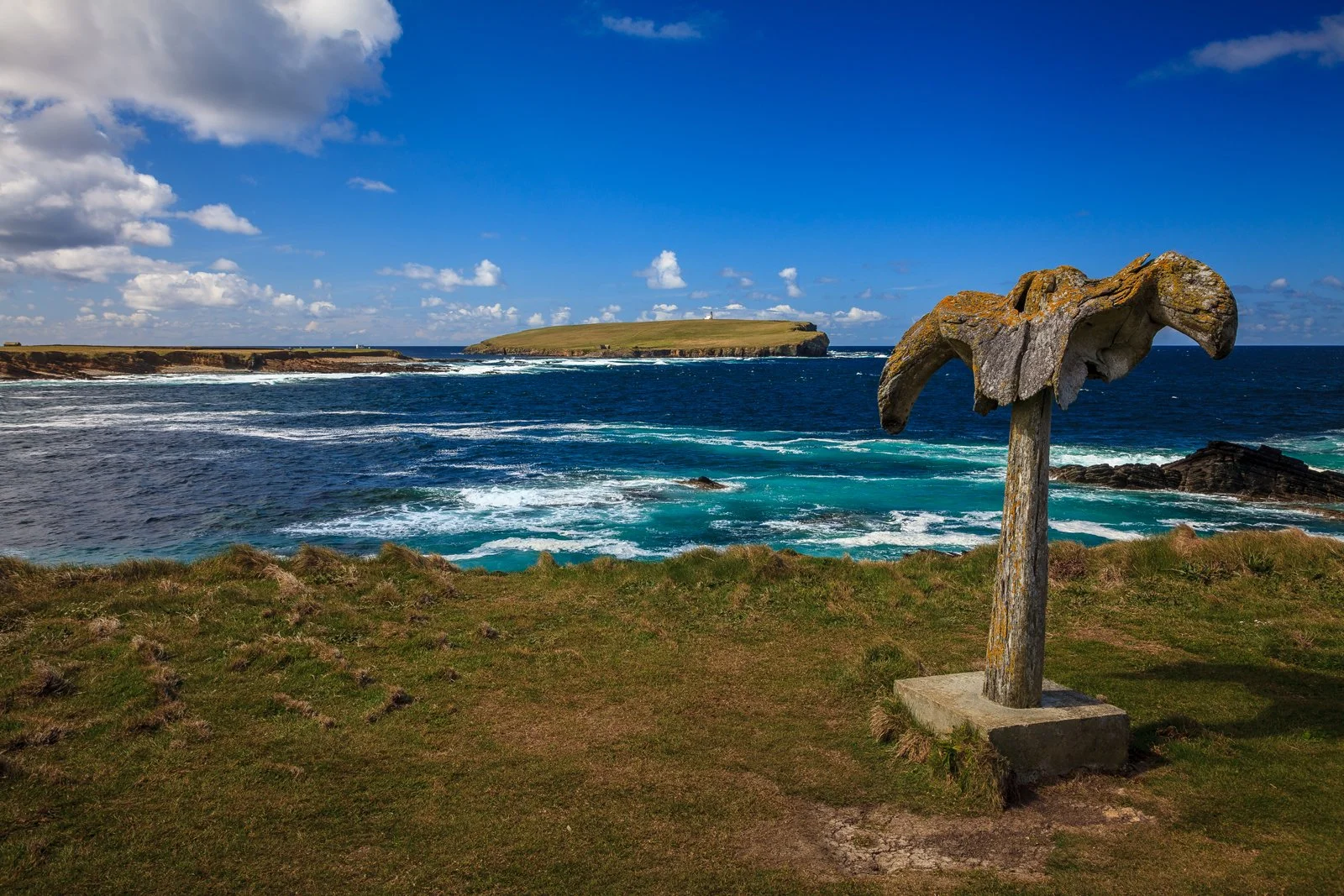
The Brough of Birsay, one of Orkney’s iconic landscapes
Like many Australians of Scottish heritage, I’ve long been fascinated by Orkney and Shetland, the remote archipelagos off the coast of Scotland, places where history feels less like the distant past than something still half-visible in the landscape and sea-mist. Their landscapes are sprinkled with remarkable Neolithic monuments, their fascination compounded by a subsequent history of Pictish, Norse and Scottish dominance.
On my first visit to Orkney, as part of a runic symposium studying the local inscriptions carved in Scandinavian runes, I flew into Kirkwall Airport, exiting the terminal under its prominent runic signage, a quaint blend of modern and medieval aesthetic that is seen throughout much of the town. For runologists, however, the true site of pilgrimage lies around 15 kilometres away, with the 5,000-year-old chambered tomb of Maeshowe acting as a kind of runic mecca. This Neolithic monument is covered in runic graffiti scratched by visiting Scandinavians who sheltered there in the twelfth century, with its most celebrated inscription proudly proclaiming: “The man who is most skilled in runes west of the ocean carved these runes …”. All runologists consider themselves to be the man (or woman) most skilled in runes.
Maeshowe chambered cairn and its runic repository
An absolute treasure trove of runic bravado, the 30 or so runic inscriptions scratched into the Maeshowe cairn offer lively descriptions of buried treasure, accommodating women, and a few interesting illustrations, including the famous carved dragon that you see on all the souvenir T-shirts sold in town. The smug Scandinavian carvers seem to have enjoyed (or imagined) the inner chamber of the mound as a trysting place for wanton women: one text gleefully exclaims that “many a woman has gone stooping in here”.
While some of the inscriptions are scant on detail, others provide perhaps too much X-rated information (please don’t ask me what Thorny did). Tamer inscriptions include the ones praising “Ingibjorg, the fair widow”, or announcing that “Ingigerd is the most beautiful woman”. Scratched beside this runic compliment is a mysterious mammal variously identified as a dolphin, an otter eating a fish, a walrus, or a slavering dog: one wonders whether Ingigerd was impressed by the zoological inaccuracy of any of this. Interestingly enough, though, we also have a carving rather unusually signed by a woman, in this case Hlif, the earl’s housekeeper, who tells us that “Jerusalem men broke this mound”.
The Norse crusaders on their way to Jerusalem did indeed break into the mound, although what they found is anybody’s guess. According to one inscription, “Hakon alone carried treasure from this mound”, although it seems most of the runecarvers missed out on the reputed riches. Several inscriptions allude to the elusive treasure: “Happy is he who can find the great wealth” is hard to dispute, although apparently “Treasure was carried away three nights before they broke this mound”. Yet another inscription insists that “Great treasure is hidden in the north-west” — a claim disputed by archaeologists, who regard it as unlikely that the burial mound ever contained any riches at all. Wonderfully eccentric claims about the mound continued down the centuries, however: one inscription was once spectacularly mistranslated as “The howe was a forsaken vault of shag-behosed swimming harpooners”. That reading has long since been discredited (indeed, the so-called “First Law of Runo-Dynamics” holds that “For every inscription there shall be as many interpretations as there are scholars working on it”).
Orkney and runes: an ongoing journey of discovery
Orkney in particular contains a remarkable number of runic inscriptions, many concentrated in Maeshowe, though several nearby burial mounds and standing stones also feature rune-like inscriptions which may be genuinely mediaeval, or modern imitations of the genuine thing. The islands are home to around sixty runic inscriptions, a number constantly being augmented, as Orkney academics seem to stumble across fragments of runestones with monotonous regularity: on a beach, on a pig farm, wherever you might care to look.
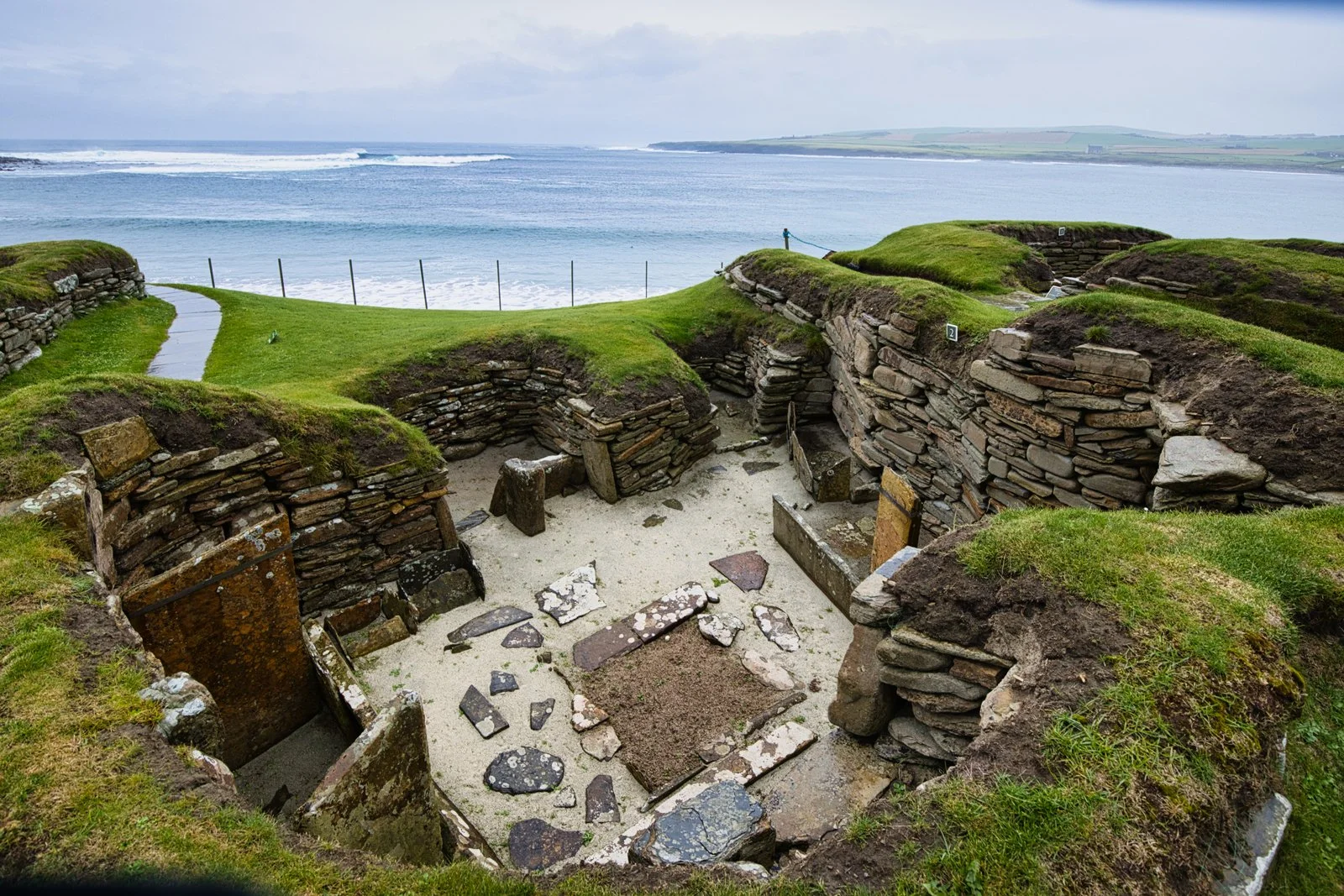
Orkney’s Skara Brae, one of Europe’s best-preserved Neolithic sites
I’m thrilled to be leading a tour to Orkney and Shetland next year. It’s not all runes of course – there are standing stones and sea stacks, the astonishingly well-preserved Neolithic village of Skara Brae, the magnificent St Magnus Cathedral, one of Scotland’s oldest, as well as whisky, Shetland ponies, dramatic sea cliffs, and landscapes that seem designed specifically for sagas. To prepare, you can read the late twelfth-century Saga of the Orkney Islanders or, if that sounds too dry, simply turn to that great bastion of culture, the Eurovision Song Contest, where Denmark’s 2018 entry Higher Ground was loosely inspired by the legend of Magnus Erlendsson, Earl of Orkney from around 1106 to 1115. Evidently a polarising figure, Magnus reportedly stayed on his ship singing psalms during battles: what some saw as piety and saintly restraint, others simply regarded as raw cowardice. In any case, in the chaos of a Viking clash I think I’d put my money on a different saga character, like Thorfin Skull-Splitter. Magnus the Martyr got a cathedral named after him in Kirkwall, but Thorfin Skull-Splitter got a “sophisticated, satiny smooth and full-flavoured” beer. There are arguments to be had about which constitutes the finer legacy.
Sagas and stones: Njal’s Saga
There’s even a tenuous link between the islands and one of the greatest and most renowned of the Icelandic family sagas, Njal’s Saga (sometimes translated as The Saga of Burnt Njal), another of the semi-historical stories written down in the thirteenth century but describing events several centuries earlier. While runes themselves are mentioned in several sagas, it’s much rarer for a saga figure to surface in an actual runic inscription. But interestingly enough, the Maeshowe text we started with goes on to reference one of the minor characters from Njal’s Saga, rather cheekily claiming to have been carved with an axe once owned by Gauk Trandilsson. Gauk is fleetingly mentioned early on in Njal’s Saga (“Asgrim … had a sworn-brother called Gauk Trandilsson, who is said to have been the bravest and most accomplished of men. But trouble arose between them, and later Asgrim killed Gauk.”) The runic inscription which refers to this same Gauk makes a bold claim: Þessar rúnar reist sá maðr er rúnstr er fyrir vestan haf, með þeiri øxi er átti Gaukr Trandils sonr fyrir sunnan land: “That man who is most skilled in runes west of the ocean carved these runes, with that axe which Gauk Trandilsson owned in the south of the country”.
Gauk was evidently slain in the late tenth century, and the likelihood of his precious axe being used for runic exhibitionism in Orkney some two hundred years later is perhaps questionable. But this inscription is remarkable from several points of view. Part of it is written in cryptographic runes, presumably as an additional flourish of scholarly vanity. The Maeshowe inscriptions are traditionally linked to the men who accompanied Earl Rognvald (aka St Ronald of Orkney) on his pilgrimage to Jerusalem in the twelfth century and it has even been suggested that this particular text may have been carved by the axe-wielding great-great-great-grandson of Asgrim Ellida-Grimsson, namely Thorhall Asgrimsson, who is mentioned in The Saga of the Orkney Islanders as the captain of the merchant ship that later returned Earl Rognvald to Orkney. We have clearly descended even further into the realm of scholarly speculation here but it’s a nice idea.
The final point about the inscription is that it seems to be somewhat alliterative and metrical. I can never read the words without hearing them in my head. At the runic symposium I attended on the Orkney Islands, an eminent runologist sang the text to the tune of Oh my darling Clementine. If you buy me a beer on tour, I might even sing it for you.
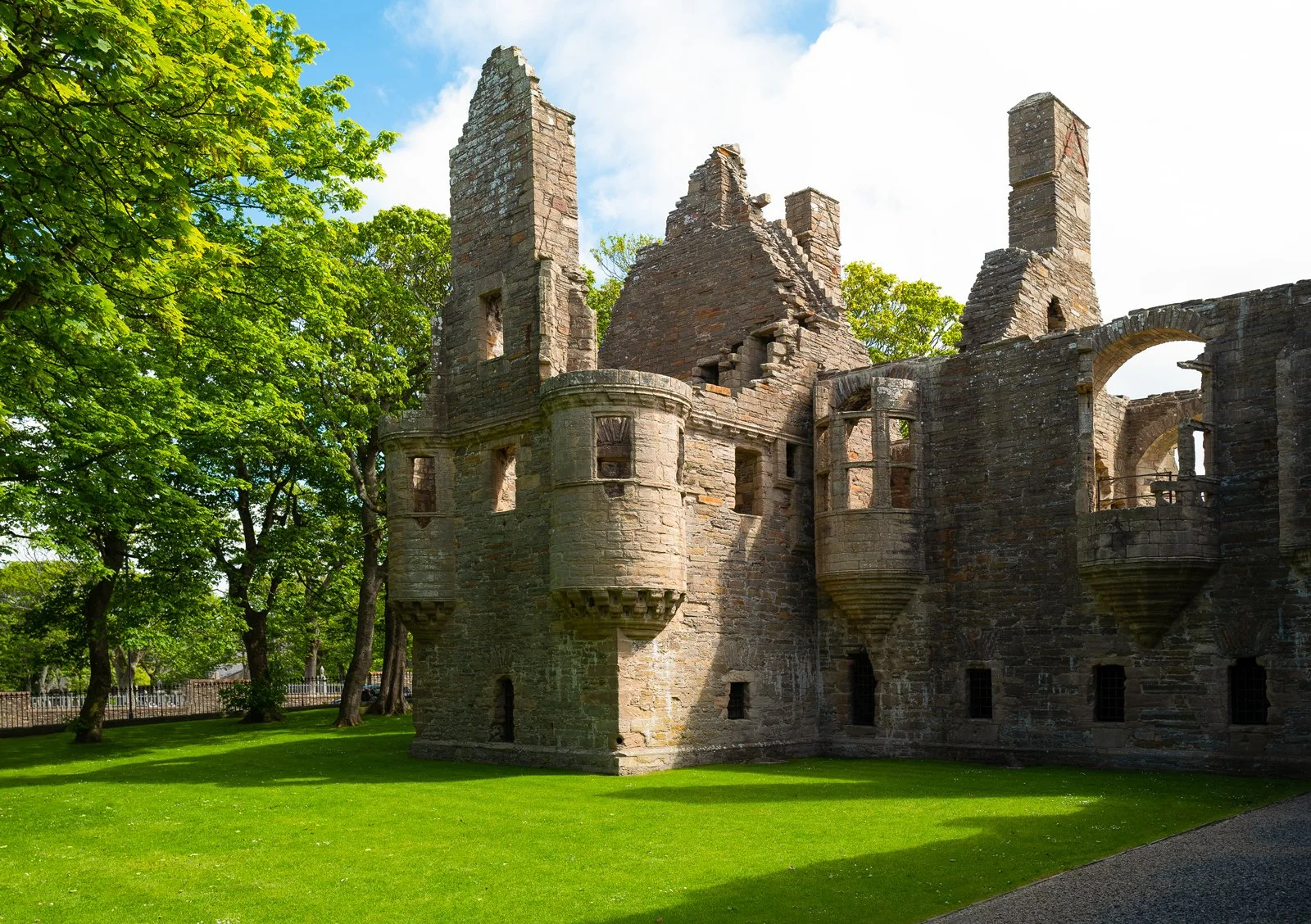
The site of Kirkwall’s Bishop’s Palace
Dr Mindy MacLeod is an academic lecturer, author, translator and editor whose work centres on the languages, literatures and inscriptions of the Scandinavian world. She completed her PhD at the University of Uppsala in Sweden and has lectured in Swedish, Old Norse, runology and linguistics at The University of Melbourne, Deakin University, and the University of Queensland. Mindy leads our tour to Orkney & Shetland in July 2027.