
Vanessa Bell, Duncan Grant and the Berwick murals
Or, how a busman’s holiday became a tour
by Kathleen Olive
Vanessa Bell and Charleston Farmhouse in East Sussex
When I was at university, a shop in the Queen Victoria Building in Sydney sold remaindered books. I made many great discoveries in there, but the most treasured is a lovely coffee table book on Charleston, the farmhouse where artists Vanessa Bell and Duncan Grant lived in East Sussex. I knew that Vanessa was the sister of one of my favourite writers, Virginia Woolf, and also a member of the Bloomsbury Group, and I was drawn in by the book’s photographs of the beautiful world she had created in the country.
Charleston was Vanessa and Duncan’s gesamtkunstwerk, a “total artwork” where they lived, loved, worked and transformed the space over time until it reflected their philosophy, aesthetics and lifestyle. The photographs showed how their own murals, sculpture, pottery and even furniture – both of them designed for the influential Omega Workshops – decorated the farmhouse and cottage-style garden. The images struck a chord with me, and I knew that I must one day visit Charleston.
Last year, I read of an exhibition dedicated to Vanessa Bell, both at Charleston Farmhouse and at the new gallery nearby, known as Charleston in Lewes. Bell’s painting and work in ceramic has long been seen as a kind of pendant to that of her lover, Duncan Grant, but this was a monographic exhibition that would exclusively examine Bell’s contributions to British Modernism. It seemed like the perfect time to visit.
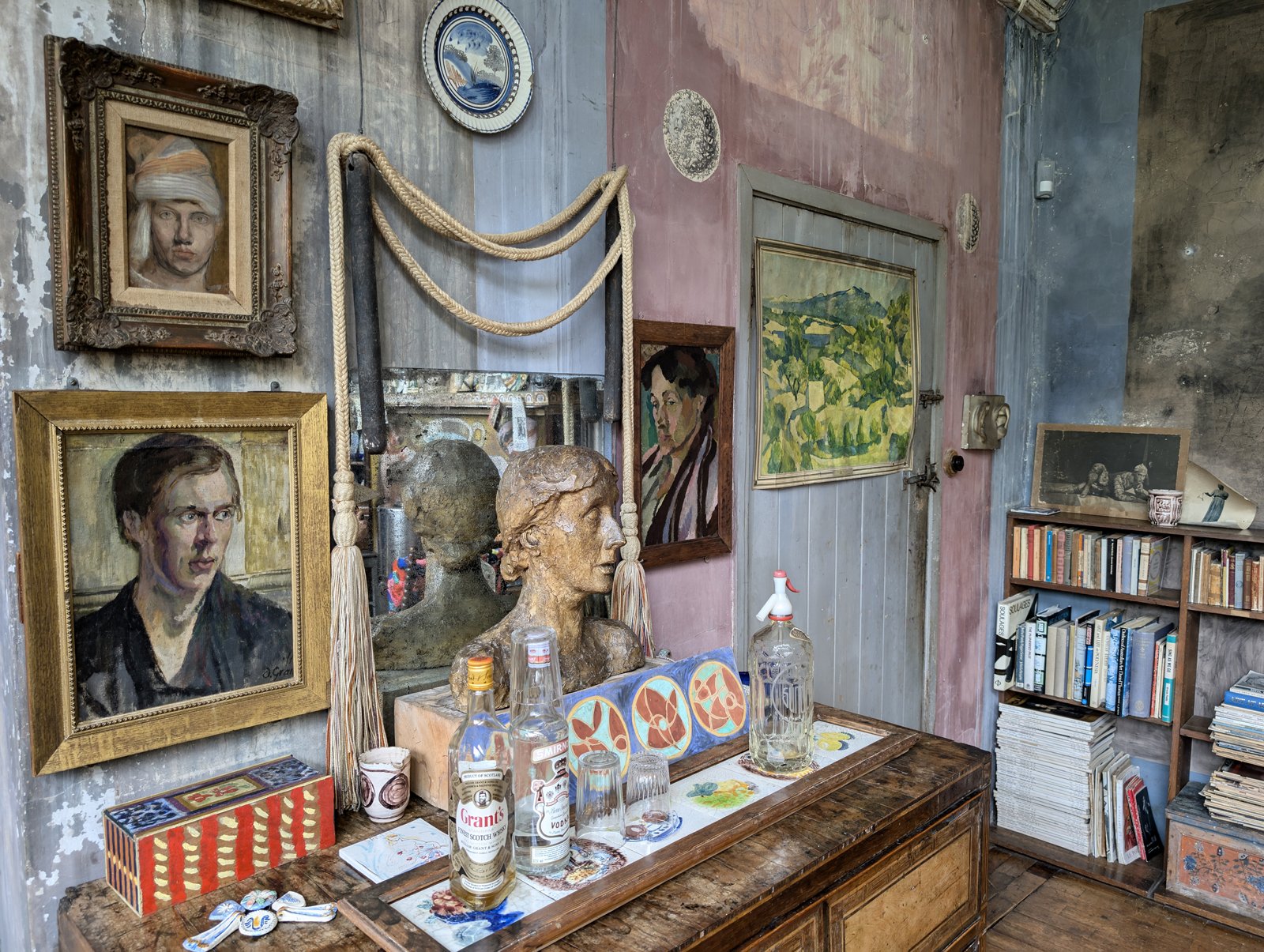
A room in Charleston Farmhouse, East Sussex, with a bust of Vanessa Bell’s sister, Virginia Woolf, and paintings and decorations by Bell and Grant
A tour is born
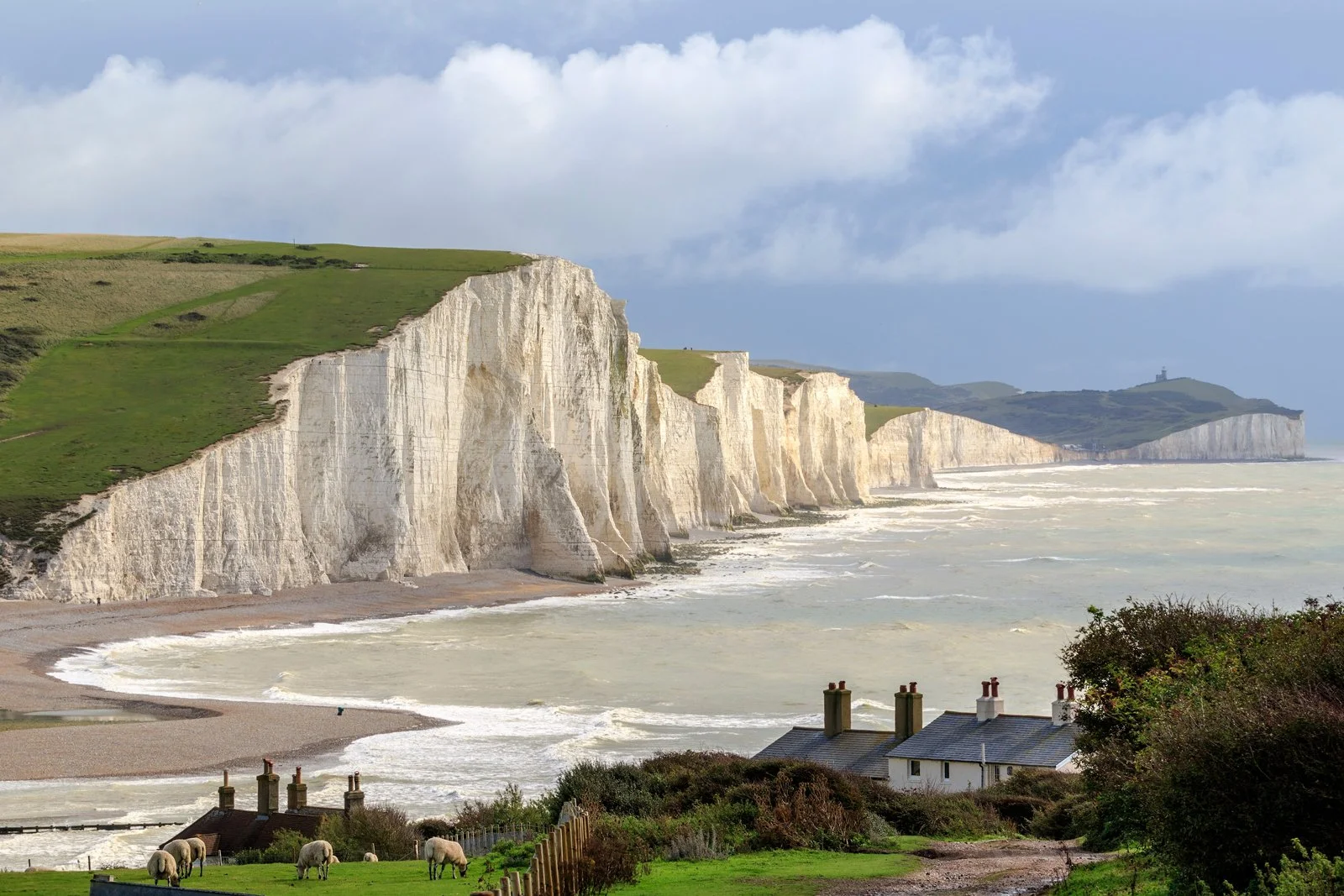
Together with a friend, I made plans to visit in spring. We rented a picturesque cottage in the hamlet of Bishopstone, not far from Seaford, and explored the Bloomsbury sites clustered in East Sussex. There was the Round House in Lewes, where Woolf and her husband Leonard briefly lived; Monk’s House, where Woolf wrote a number of her most important works and where, in the nearby Ouse River, she later drowned. We visited Charleston Farmhouse and the excellent exhibition in Lewes, and of course walked the amazing Seven Sisters, the white chalk cliffs that face across the Channel to Dieppe (below).
It was a lovely trip, with sides of English cottage-core and cream teas, and, enthused, I soon mentioned the possibility of a Bloomsbury-in-Sussex tour to my colleagues. Naturally they laughed at me: tour leaders are always taking busman’s holidays and then trying to pitch them as the “perfect tour”. But when someone rang our office out of the blue the following day, to ask if we ever organised Bloomsbury Group tours (I promise it was not me in disguise), we decided to put the idea through our planning process.
Once an itinerary made it all the way through our product planning cycle, I knew the ideal tour leader would be Penny Gay, Professor Emerita at the University of Sydney and an expert on Virginia Woolf. Penny had taught me when I was an undergraduate, so I knew she was a passionate and convincing communicator. Our tour, In Sussex with the Bloomsbury Group, was born!
Berwick Church: wartime murals from the Bloomsbury Group
There was one place I had visited in East Sussex that I was particularly keen to see on a tour itinerary. This was the church of St Michael and All Angels, probably constructed in the twelfth century under the Normans – Berwick is only about 30km from Hastings – and lying at the foot of the South Downs. The “Bloomsberries” who decamped to East Sussex for peace and space to work in the lead-up to World War II, from Virginia Woolf to Vanessa and Clive Bell and visitors such as Roger Fry, spent a great deal of time in this inspiring landscape, and it is easy to understand why when you visit Berwick.
The old medieval building is surrounded by a tranquil cemetery, and the rambling Tudor Gothic rectory, now a private residence, is just steps away across a tiny country lane. Nearby there is a storybook cottage with a thatched roof, the church noticeboard is full of information about baptisms, weddings and vestry meetings, and the humble flower displays clearly come from a parishioner’s garden. It is exactly what one wants from a church in the English countryside.
But the unexpected element of St Michael and All Angels is what brings visitors there. In the early days of World War II, George Bell, Bishop of Chichester (and no relation to Vanessa), decided that English churches were lacking in the kind of uplifting decoration that filled their famous Italian counterparts. Thinking back on the Italian Renaissance, and on the role of the Church and its prelates as patrons of great art, he decided to commission a series of mural decorations for the interior of the Berwick church.
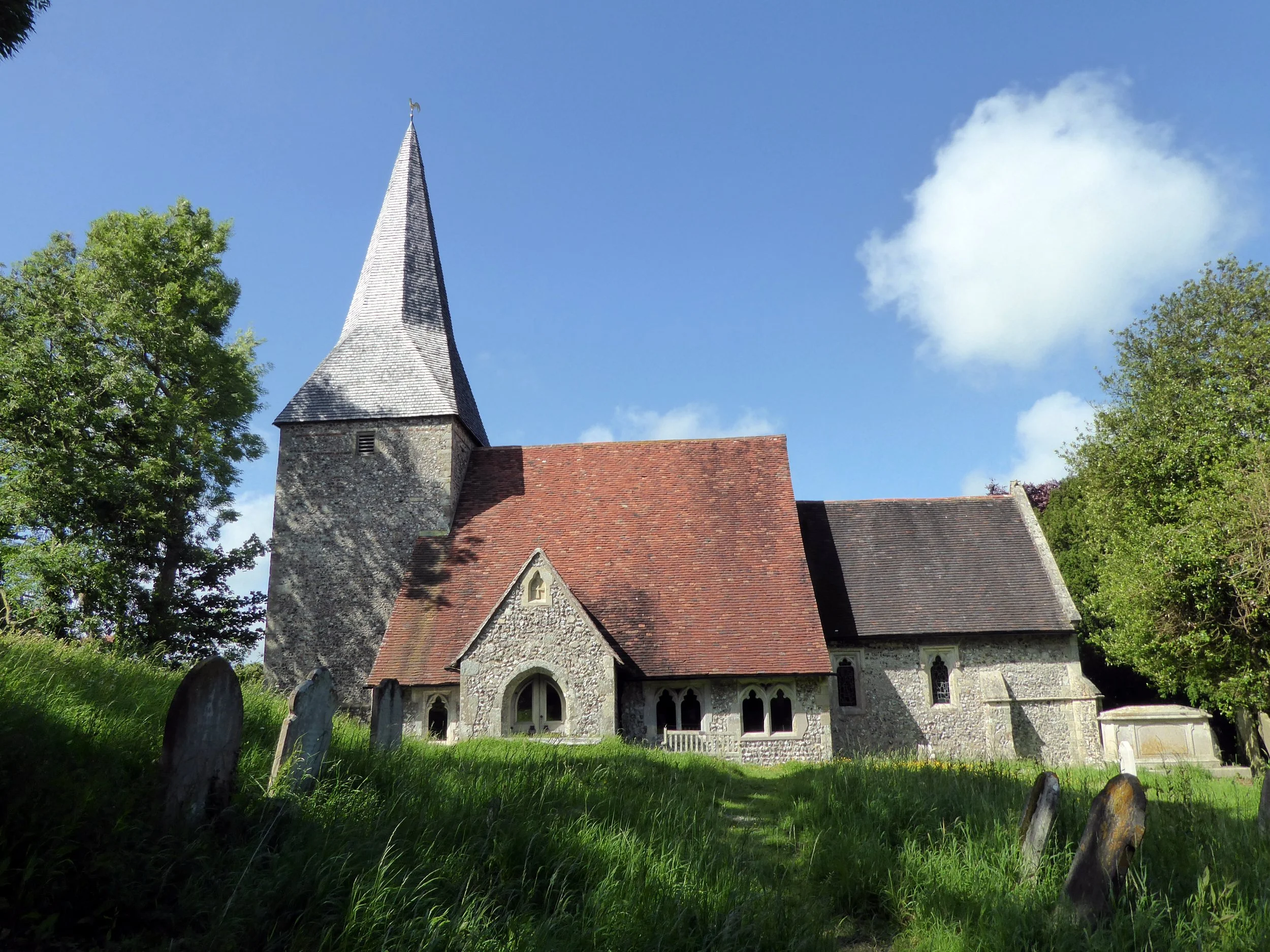
Berwick church (courtesy Paul Farmer, Wikimedia Commons, CC BY SA 2.0)
The onset of war was causing anxiety for the Bloomsberries in East Sussex. A number of them had first decamped here during the First World War, working as conscientious objectors on local farms in lieu of military service. A core group, including the Woolfs and Bells, had stayed on, enjoying the proximity of East Sussex to London as well as to the country seats of friends, such as Vita Sackville-West at Sissinghurst, and the affordable lifestyle and space for artistic endeavour that it offered.
Increasingly, however, geography meant that World War II encroached: bombers flew over East Sussex during the Battle of Britain, memorably recorded by Virginia Woolf in her last novel Between the Acts. One hundred kilometres from Berwick, a flotilla of boats would later cross the Channel to evacuate Dunkirk. In 1944, the church’s ancient leaded windows were blown out by a German Doodlebug. The bishop’s spirit-lifting art project would be sorely needed.
“Even small beginnings help,” he wrote.
The personal dimensions of a timeless story
In 1940, Bishop Bell commissioned Vanessa Bell and Duncan Grant, then living at Charleston, to decorate Berwick church with murals. Neither artist was religious, but both had a great love of Italian sacred art – particularly the so-called “Primitives” of the Early Renaissance: Fra Angelico, Piero della Francesca. Vanessa’s oldest son, Julian, had been killed in the Spanish Civil War, and in 1941, just as the church committee decided on Grant and Bell’s proposal for the paintings, Woolf drowned herself in the Ouse. War was becoming personal: the Berwick murals were made at a time of great grief.
Vanessa’s work at Berwick concentrates on two important gospel moments: the Annunciation to the Virgin Mary by Archangel Gabriel of Christ’s incarnation, and the Nativity of Christ. These scenes are surely also among the most significant moments in Mary’s own life, a mother aware of the suffering that must come to her son. (Grant painted the nearby Crucifixion, the realisation of the mother’s fears.) Bell’s Annunciationis a study in light, with Archangel Gabriel and Mary kneeling before a large fictive opening that lights them from behind. The window onto a loggia shows a walled garden beyond, recalling the “hortus conclusus” of fifteenth-century Annunciations by Lorenzo Monaco or Fra Angelico. The closed garden is a typical symbol in the Renaissance of Mary’s virginity, but, to my mind, its flowers suggest the walled garden of Charleston, and its neat rows of vegetables in the distance presage the Victory gardens that became a wartime duty.
Gabriel and Mary gesture to one another in a classically Renaissance style: he lifts his left hand in a blessing that Mary bows her head to receive, and in his other hand holds the lily that is the Annunciation’s well-known iconography. Mary listens to Gabriel’s surprising news with one arm bent across her chest in a symbol of humble acceptance, and her bright blue mantle loops across the floor, connecting her to Gabriel as much as the two figures are also separated by a fictive wooden column that supports the loggia beyond, another classic Renaissance device.
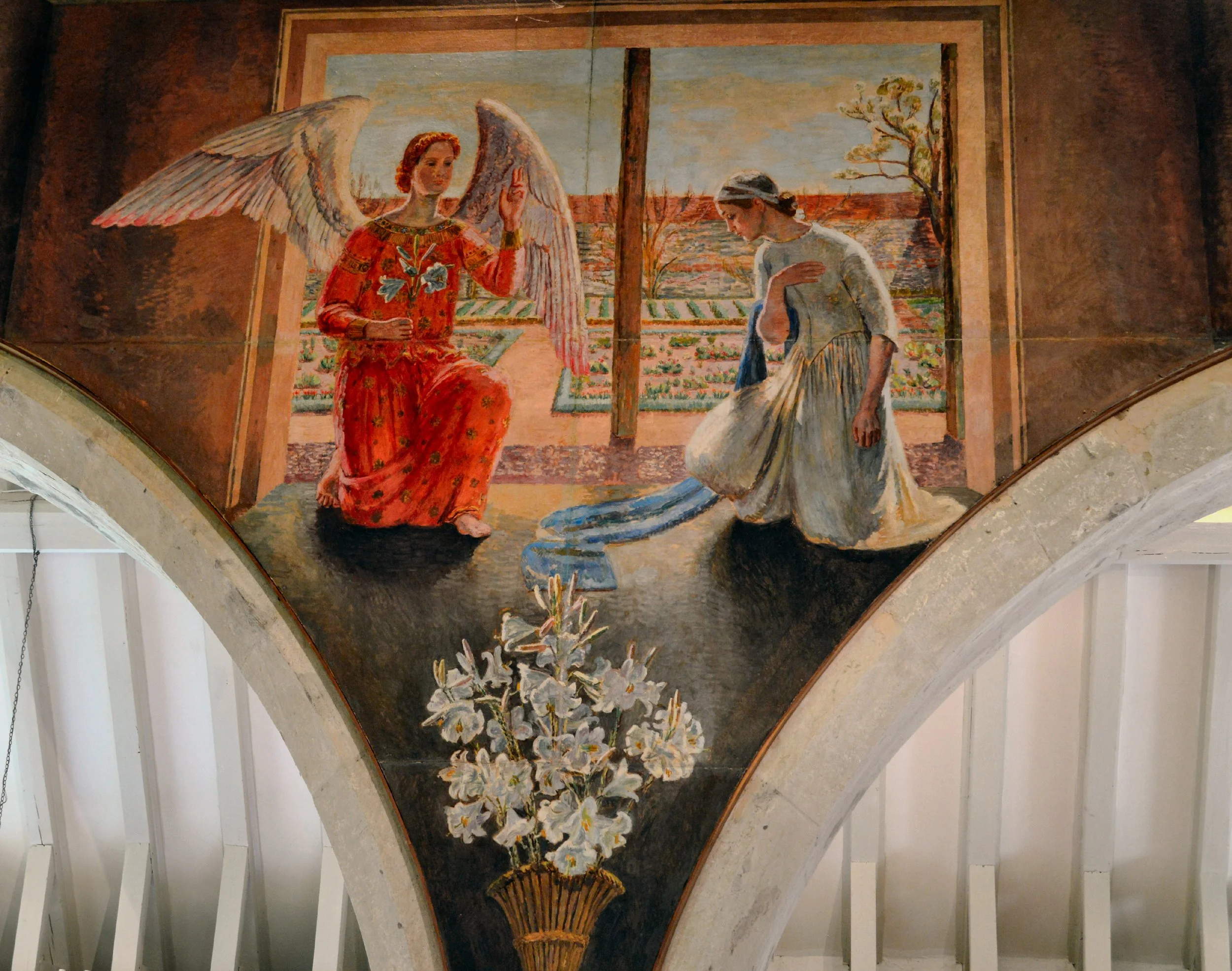
Bell and Grant’s daughter Angelica posed for the Virgin Mary in the Annunciation scene (courtesy Andy Scott, Wikimedia Commons, CC BY SA 3.0)
Vanessa’s Nativity scene is very different. It seems to reflect her own state at this time, grappling with the losses of her son and sister. Now the natural light is far on the horizon and the landscape is therefore thrown into darkness. The figures at the Nativity are instead lit by an artificial source, the lantern held by a shepherd who kneels before Mary and Christ, so that all but the figure of Christ are thrown into a flickering half-light. Christ, as is tradition, generates the source of his own light, a bright pool at the centre of the scene that seems to lend it its only hope: the other figures, with the exception of Mary in her blue and pink, are clothed in dun colours and look sombre and stiff. Mary’s eyes seem like dark, empty pools and, despite her hands caressing her baby, she seems to be far away, disconnected from the scene. Does she already foresee the death of her son?
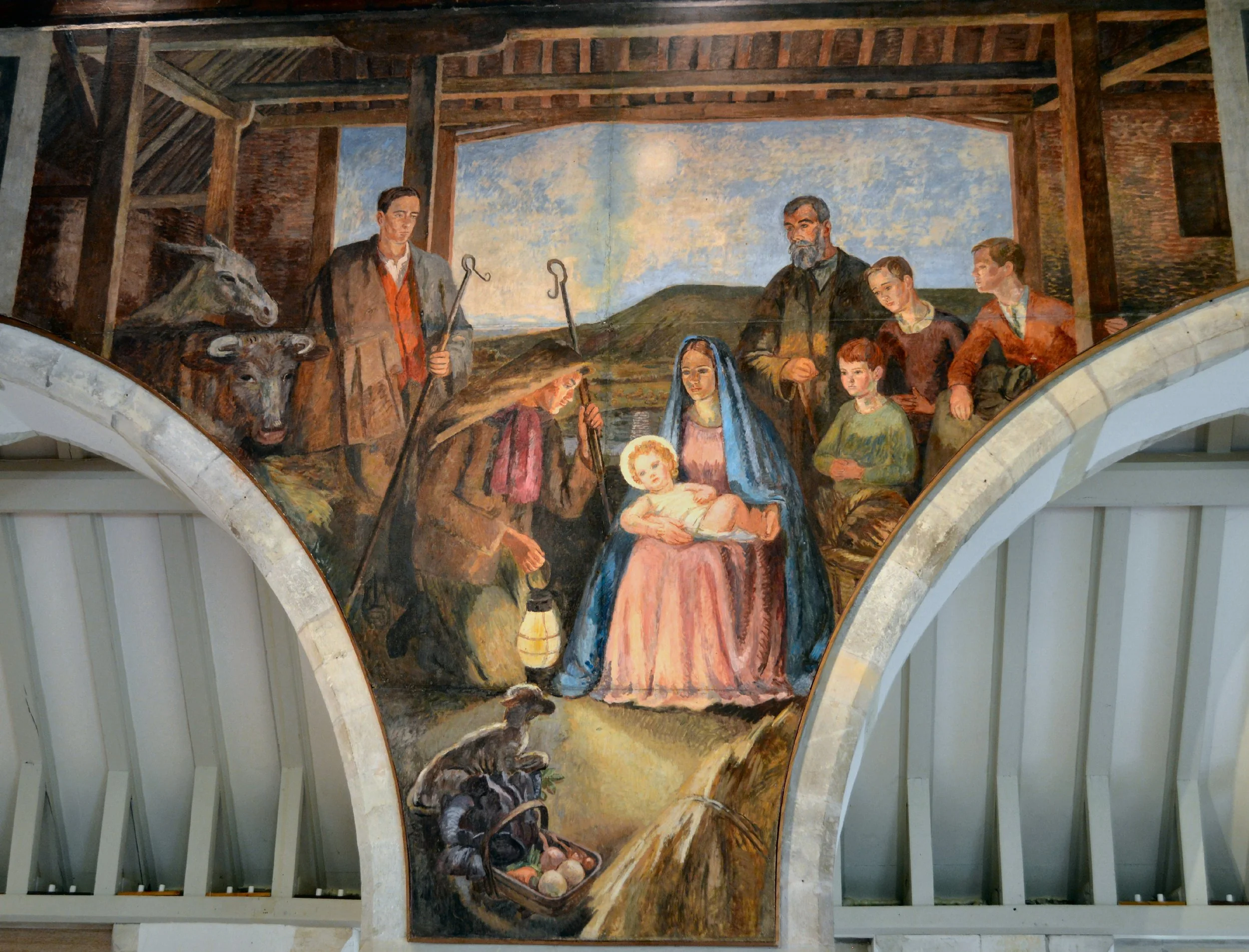
Vanessa Bell’s deeply personal rendering of the Nativity at Berwick (courtesy Andy Scott, Wikimedia Commons, CC BY SA 3.0)
A family of artists
The murals at Berwick were a family project: Duncan Grant and Vanessa Bell – who were life partners despite Vanessa’s marriage to Clive and Grant’s preference for relationships with men – had had a daughter, Angelica. It was Angelica who posed for the Virgin Mary. One of Vanessa’s friends modelled for Gabriel, draped in sheets while lying on an armchair, and all the other figures in Berwick church are taken from local farmers and shepherds who modelled for the artists inside a barn. (It’s hard to envy Grant’s friend, tied to an easel to model for the figure of Christ in the large Crucifixion scene.) The landscapes shown are those of this family: the South Downs, the Cuckmere River outside this church.
After being painted on plasterboard at Charleston or in farm buildings near Berwick, the paintings were attached to the walls of the church. But the project did not end with Bell and Grant. Vanessa’s son, Quentin, painted a number of panels on the chancel arch with the parable of the Wise and Foolish Virgins – its moral, focused on spiritual readiness, was certainly relevant in wartime – and Quentin also painted a series of the Holy Sacraments. The pulpit, which Vanessa had decorated with angelic figures, was repainted by Duncan Grant in 1962 after it was defaced, and now shows lovely vases of symbolic flowers, very “Bloomsbury” in their loose style.
Berwick church is luminous and intimate, and it’s not hard to imagine the impact that these murals have had on the congregation over the decades. As someone who studies the Italian Renaissance, I imagine that it was very similar in effect to that of the great church fresco cycles of the fifteenth century: looking at the artworks, one picks out the faces of people one knows, models for or patrons of the work. The buildings are not those of first-century Palestine, but rather those of my own town; the landscape is what I’d find if I went beyond the city walls. While the iconography and symbols teach me the overarching Christian story that I look upon, I am also encouraged by association to reflect on its direct relevance to my life. This is the immediacy, and a part of the power, of the artists’ work.
Of the many lovely Bloomsbury sites I visited in East Sussex, all of which are included on our upcoming tour, it is nevertheless the Berwick murals that will stay with me.
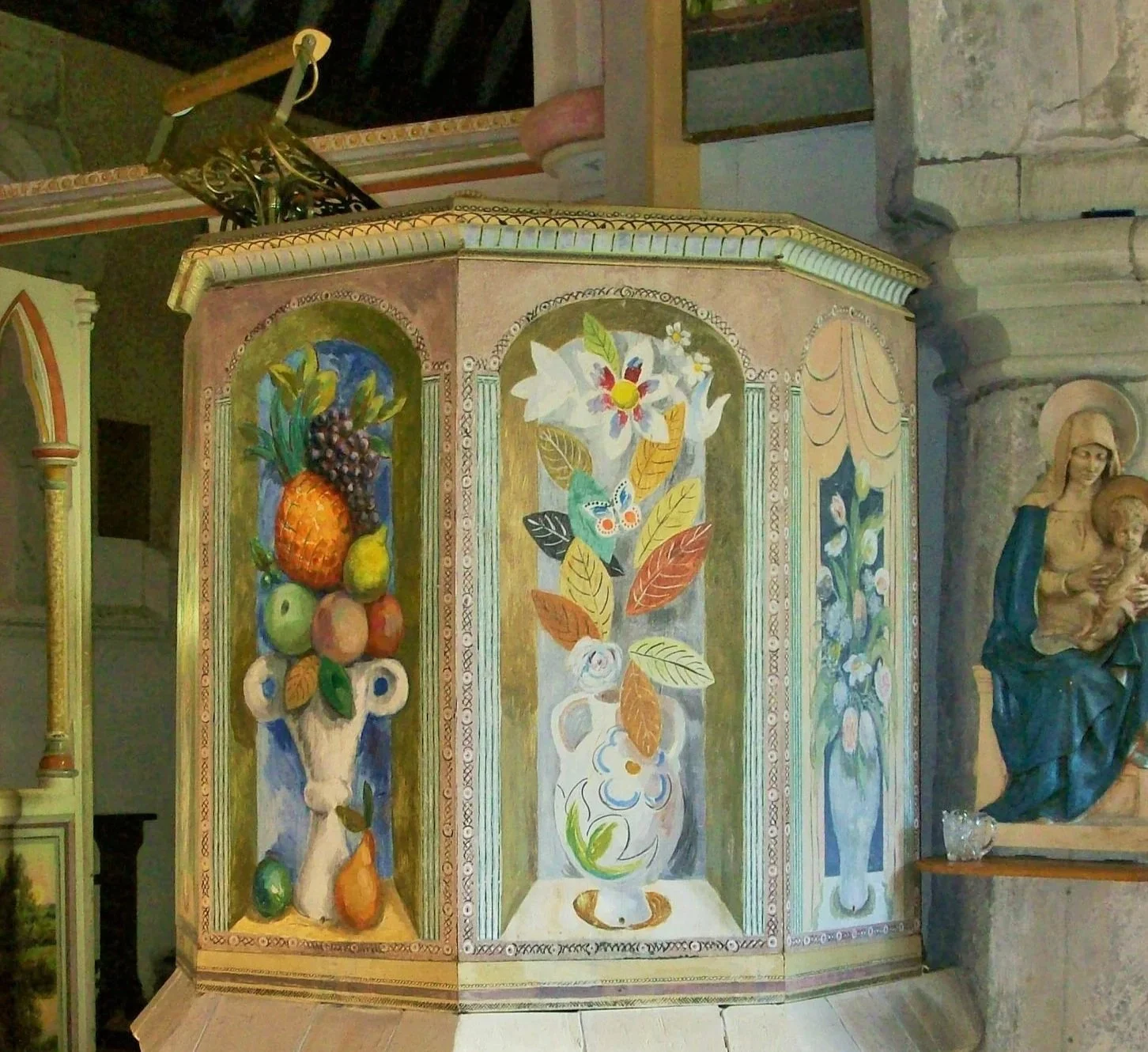
A very Bloomsbury pulpit, by Vanessa Bell with conservation by Duncan Grant (courtesy Poliphilo, Wikimedia Commons, CC BY SA 3.0)