
Destination guide to the Bardo National Museum, Tunis
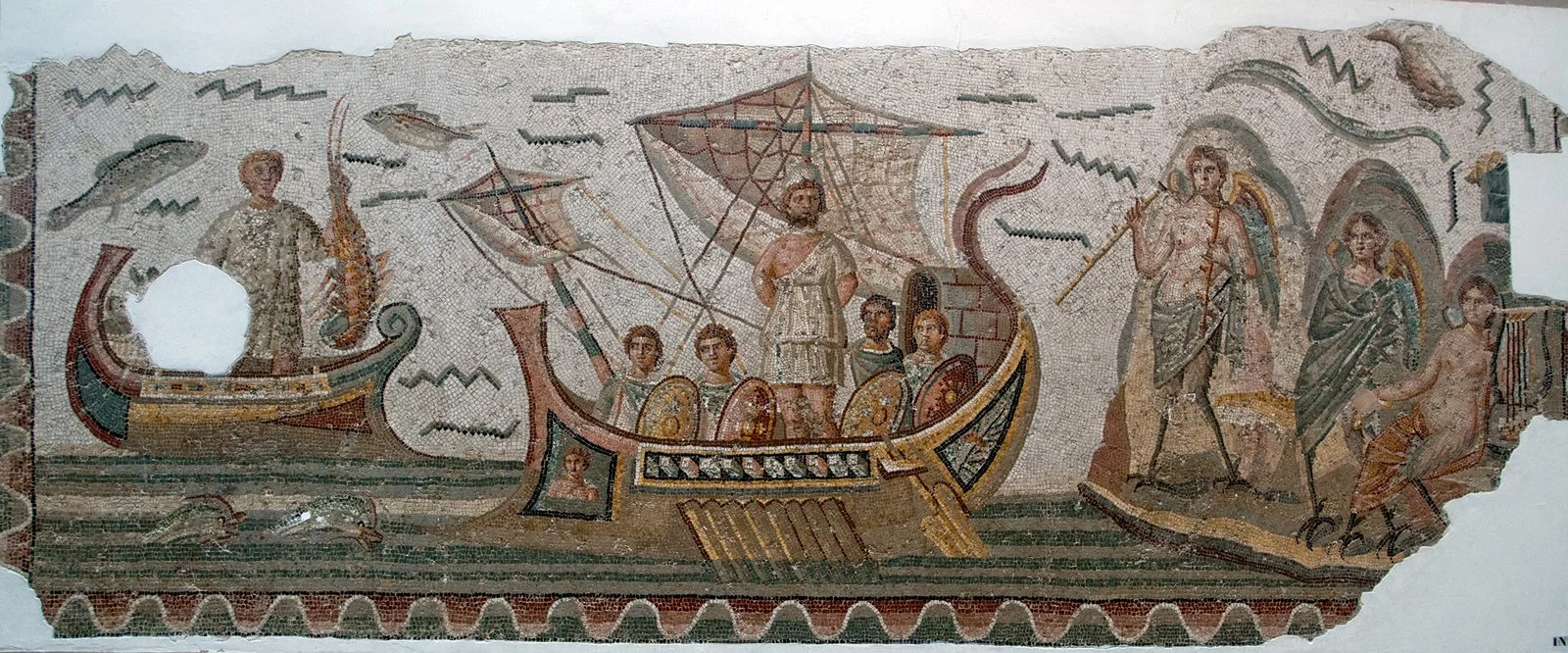
Odysseus listens to the mermaids, 3rd century CE mosaic from Dougga, now in the Bardo National Museum (photo Jerzy Strzelecki, Wikimedia Commons, CC BY SA 4.0)
Uncover Tunis’s extraordinary Bardo National Museum, Africa’s second largest museum and one of the world’s best places to admire ancient Roman mosaics, in this destination guide to its history and highlights.
The Bardo National Museum in Tunis is one of Tunisia’s undisputed gems of history and art, a staggering archaeological collection that is the second largest museum in Africa after the Egyptian Museum of Cairo. In this destination guide, we look at its history and the highlights of its expansive collection.
History of a national museum
It’s a truism that we have the age of European colonisation to thank for great collections of Mediterranean archaeology. We might think of Elgin and his marbles, Napoleon and Egypt, or Belgium’s Leopold II in the Congo. But this is a limited view of the history of archaeology and its passionate proponents who assembled outstanding collections. The Bardo National Museum in Tunis is a good example of this.
It was in the 1860s that Muhammad Khaznadar, an archaeologist and the eldest son of Tunisia’s prime minister, proposed bringing together a national collection in the Bardo palace of a bey. These high-ranking vassals ruled provinces on behalf of the Ottoman Empire, and many of them lived in a separate quarter of Tunis, known as the Bardo. Filled with palaces in lavish Moorish and European styles, the Bardo was a centre of power where even the treaty signed by Mohammed el-Sadik Bey with the French Protectorate took place in 1881.
Parts of the grand complex in which the Bardo is housed date back to the fourteenth and fifteenth centuries. The archaeological artefacts collected here were opened to the public in 1888, making this Tunisia’s oldest museum, and rooms such as the Grand Salle des Fêtes (a ballroom), the harem and a sequence of patios evoke the lifestyle of the beys at the same time as they offer a vast, comfortable and light-filled space in which to explore the museum collections.
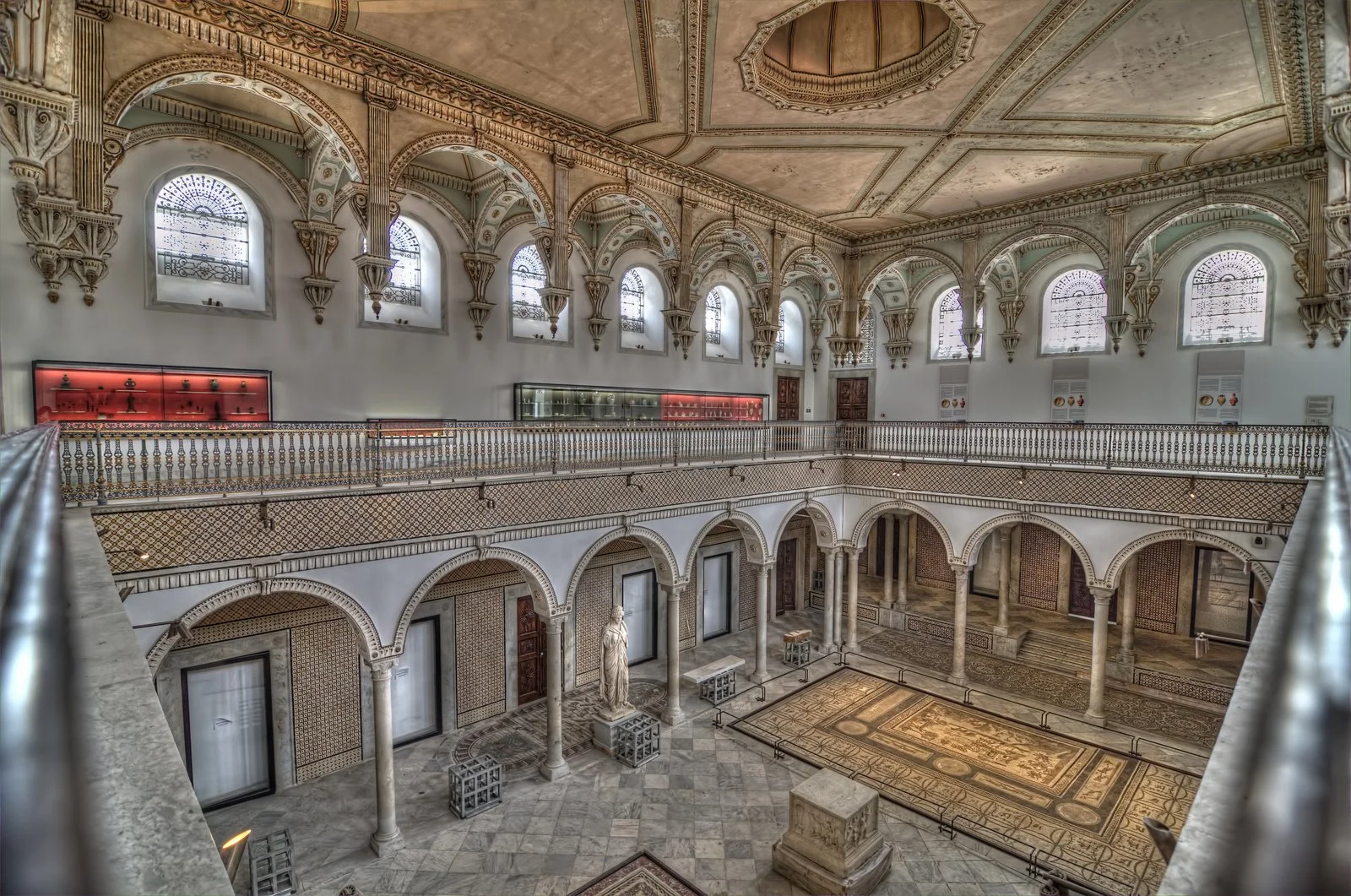
View of a grand hall in the museum (photo Walid Mahfoudh, Wikimedia Commons CC BY SA 4.0)
Mosaics and other Roman artefacts in the Bardo National Museum
The collections of the Bardo National Museum are encyclopedic, to say the least, and it’s hard to understate their importance for scholars of the ancient Mediterranean. They are particularly significant with respect to Roman mosaics, offering one of the world’s largest and most impressive collections.
North African mosaicists were among the ancient Roman world’s most sophisticated artisans, drawing on a wide range of tiles or tesserae made from local stones, coloured class, and pottery fragments in order to represent a broad chromatic scale. They had an eye for design and for visual drama, a technical understanding of the architecture in which their works would be installed, and an ability to work with varied types of materials.
Specialised teams moved across vast swathes of Roman territory – North African mosaicists are thought even to have contributed to the works at Sicily’s Villa del Casale in Piazza Armerina – and their work could cover floors and walls on a large scale.

The Virgil Mosaic (photo Boyd Dwyer, Wikimedia Commons CC BY SA 4.0)
The Bardo’s collection is particularly revealing when it comes to the mosaicists’ depictions of the everyday life of the Roman élite: a number of the mosaics depict hunts, for example, both in the countryside but also staged in venues for public entertainment. There are elegant women at their toilet, with maidservants holding up mirrors or offering jewellery, as well as chariot races in hippodromes and even a scene showing a party for the theatrical producers of popular hunting games.
One of the best-known works in the collection, excavated in 1896 in a garden in Sousse, offers the oldest portrait of the poet Virgil. He holds an extract of the Aeneid while the muses Clio and Melpomene stand beside him, at the ready. Another part of the mosaic collection documents the transition from Rome’s pagan pantheon to the rise of Christianity: Daniel in the lion’s den, Christian funerary monuments, and views of Jerusalem and Bethlehem.
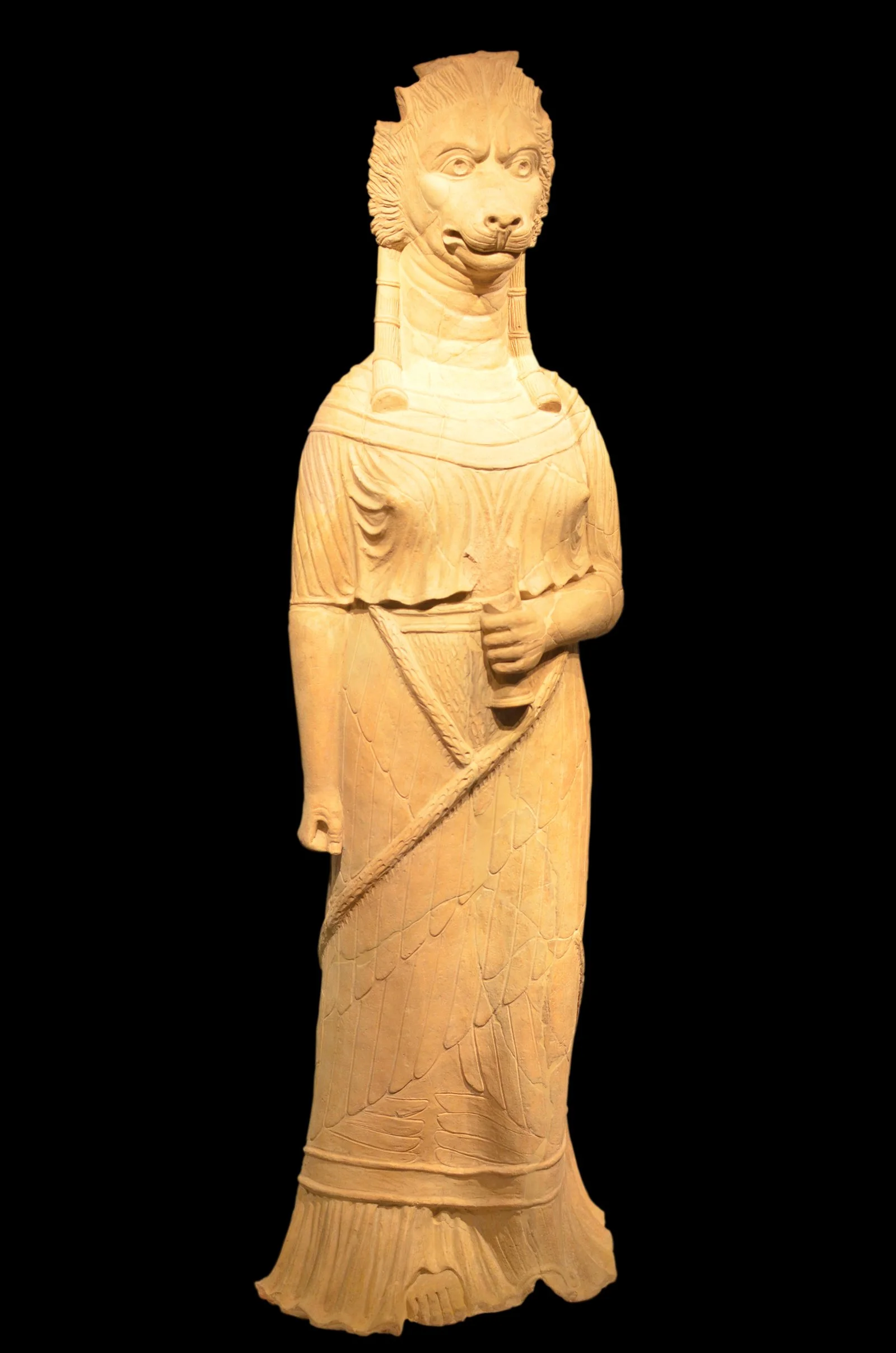
A statue of Tanit with a lion’s head (photo Alexander Van Loon, Wikimedia Commons CC BY SA 4.0)
Treasures of ancient Carthage
“Carthage must be destroyed.” So said Cato the Elder, and his famous dictum has influenced how many of us think about ancient Carthage to this day. Even though the Roman Republic destroyed the Punic city in 146 BCE, razing and burning it to the ground before constructing a new city over the top, we have still been left with significant material examples of the Punic and Carthaginian cultures in North Africa.
The Carthaginian section of the museum is one of the Bardo’s most fascinating aspects, offering a window on a sophisticated society and the tangible manifestations of its religion, decorative arts and martial power. The Ksour Essef cuirass is a prime example, found in 1909 in a Punic tomb not far from the town for which the breastplate is named. Usually dated to the fourth or third century BCE, it seems to have been made by Carthaginians but must have been inspired by the armour that Hannibal and his troops saw in Italy during the Second Punic War. It is made of gilded bronze, a fierce helmeted Medusa staring out at the wearer’s foe.
The museum also contains many representations of Tanit, a chief Carthaginian deity who was the consort of Baal Hammon. A matriarch and goddess of fertility and rain, she also represented wisdom, civilisation, arts and crafts, and even war. A powerful statue shows her as Tanit Leontocephalus, or with a lion’s head, while many stelae show her in a more abstract form. This so-called sign of Tanit is a collection of angles and circles that together offered an apotropaic effect against the evil eye.
In other rooms, objects excavated in Carthaginian cemeteries offer a perspective on daily life, from delicate gold jewellery to a third century BCE baby’s bottle made of terracotta. Eyes painted alongside the bottle’s spout turn the simple round form into a cheerful human face.
Roman sculptures in the Bardo National Museum
The museum also boasts an outstanding collection of ancient Roman sculptures. Most of these are in stone and many are life-sized. They often depict historical figures, as well as lesser-known everyday Romans from North Africa: consuls, for example, or a tomb portrait of the deceased in the guise of Hercules.
There are also numerous life-sized sculptures of mythological figures. Hercules is well-represented, but Bacchus is not far behind, and there are many beautiful works dedicated to popular Venus. A second-century work shows her in a group, together with Eros, while another work of the same period shows her in the famous pudica pose, covering herself with graceful gestures and her delicate robes as she turns away from the viewer in an elegant contrapposto movement.
How to approach a visit to the Bardo National Museum
As you’ve no doubt guessed, this is a museum that needs time to appreciate to the full. On our tours to Tunisia and Algeria, we allow an entire morning in the museum, with time to appreciate the highlights together with your tour leader and guide before time at leisure to continue your explorations.
While the museum isn’t brimming with chairs and benches on which to rest, the proportions of each room are very generous, thanks to the complex’s history as an aristocratic residence. As a consequence, the museum doesn’t feel crowded – even when you encounter other tour or student groups – and the excellent ambient light allows you to appreciate the detail of the mosaics in particular.
There is a simple café in the museum’s peaceful patio garden, which is well worth a stop. You can relax on comfortable couches while enjoying tea, coffee or freshly squeezed juice – pomegranate is a specialty when in season – and admiring the museum’s resident cats.
And if you’re arriving early into Tunis, to join one of our tours, we wouldn’t discount a pre-tour visit to the museum, so that you can orient yourself to its extraordinary range of artefacts before returning with our expert tour leaders.

Venus pudica (photo Céline Rabauda, Wikimedia Commons CC BY SA 4.0)