
Valparaíso destination guide
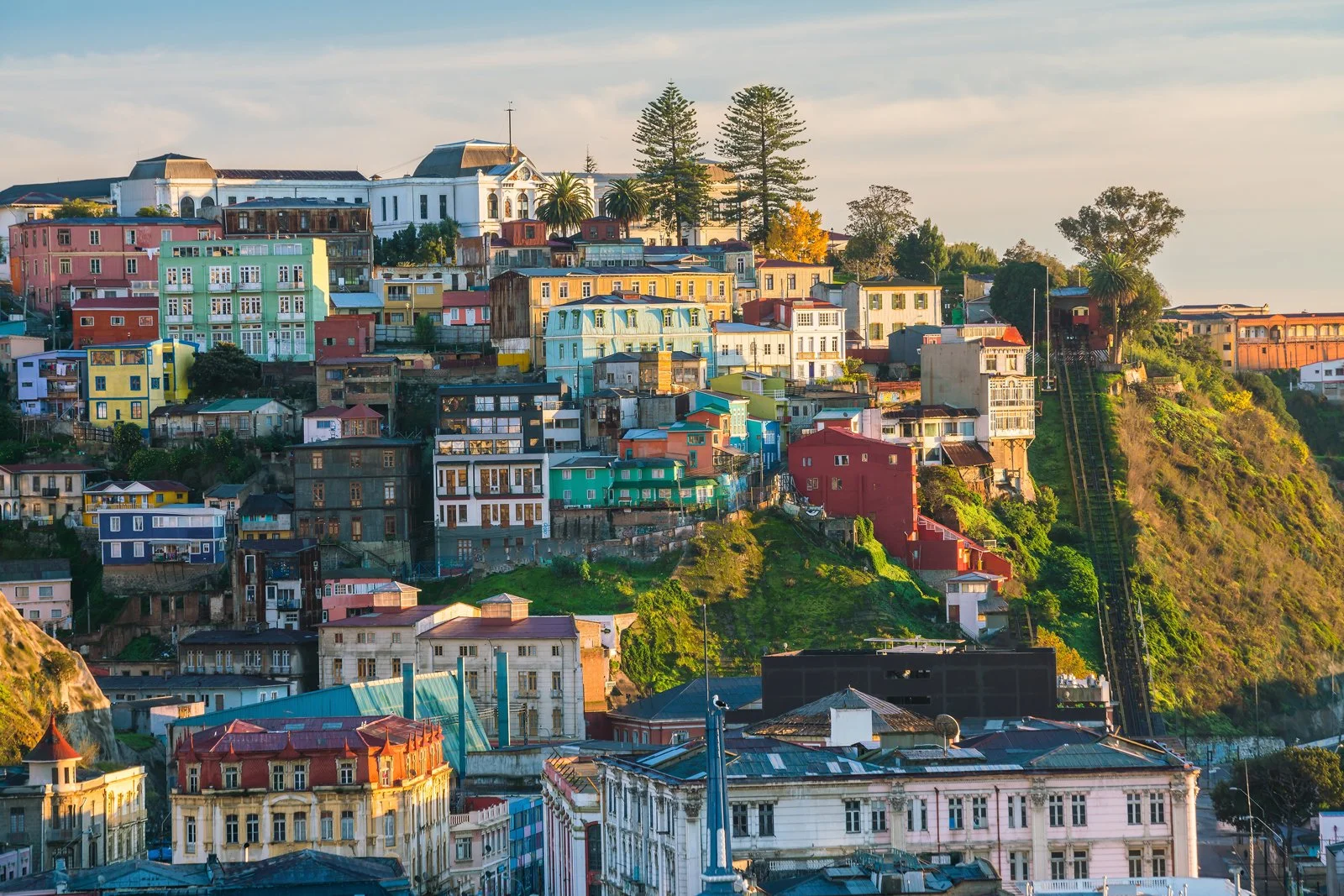
Colourful Valparaíso and one of its many funiculars
by Irene Lewis
Discover Valparaíso in Chile, a colourful seaside city of historic funiculars with proximity to a region of fine wineries. Valparaíso charms its travellers with its amphitheatre-like cityscape, eclectic port architecture, and vibrant creative culture, the home of Nobel Prize-winning poet Pablo Neruda.
Valparaíso as a port city
Valparaiso, Chile’s third-largest metropolitan city, became an established international port following nineteenth-century urban development. With its favourable coastal location, the city became a natural stopping-point for ships travelling between the Atlantic and Pacific oceans. Following a population boom, Valparaíso grew in eclectic ways, with unconventional architecture and infrastructure cleverly designed to suit its hilly, seaside topography.
The early maritime history of Valparaíso is evident at the Villaurrutia pier, established in 1810 by a local merchant and the first of many constructed to facilitate the growth of international trade after the 1820s and ‘30s, and to allow ships passing from Cape Horn in southern Chile to undergo repairs and repainting upon arrival in Valparaíso. This was Valparaíso’s Golden Age, with an influx of commercial business owners, migrants and visitors – American painter James McNeill Whistler and English artist Thomas Somerscales both captured and immortalised the city’s bustling port scene.
A devastating earthquake in 1907 and the opening of the Panama Canal in 1914 put an end to this brilliant period, but the city retains much of this historic charm. From vibrant nineteenth-century buildings made from recycled ship parts and coloured with leftover ship paint – thus protecting homes from humidity and salt – to the murals and street art that saturate the city in colour, Valparaíso has its reputation as one of South America’s most colourful cities.
Like many port cities with a complex and hilly geography, Valparaíso outgrew its limited flat areas, and its array of hills was repurposed in its narrow, maze-like street formations, peppered with hidden staircases and intricate hole-in-the-wall stores. This also created a demand for suitable transport for residents, leading to another distinctive characteristic of the city: its funiculars.
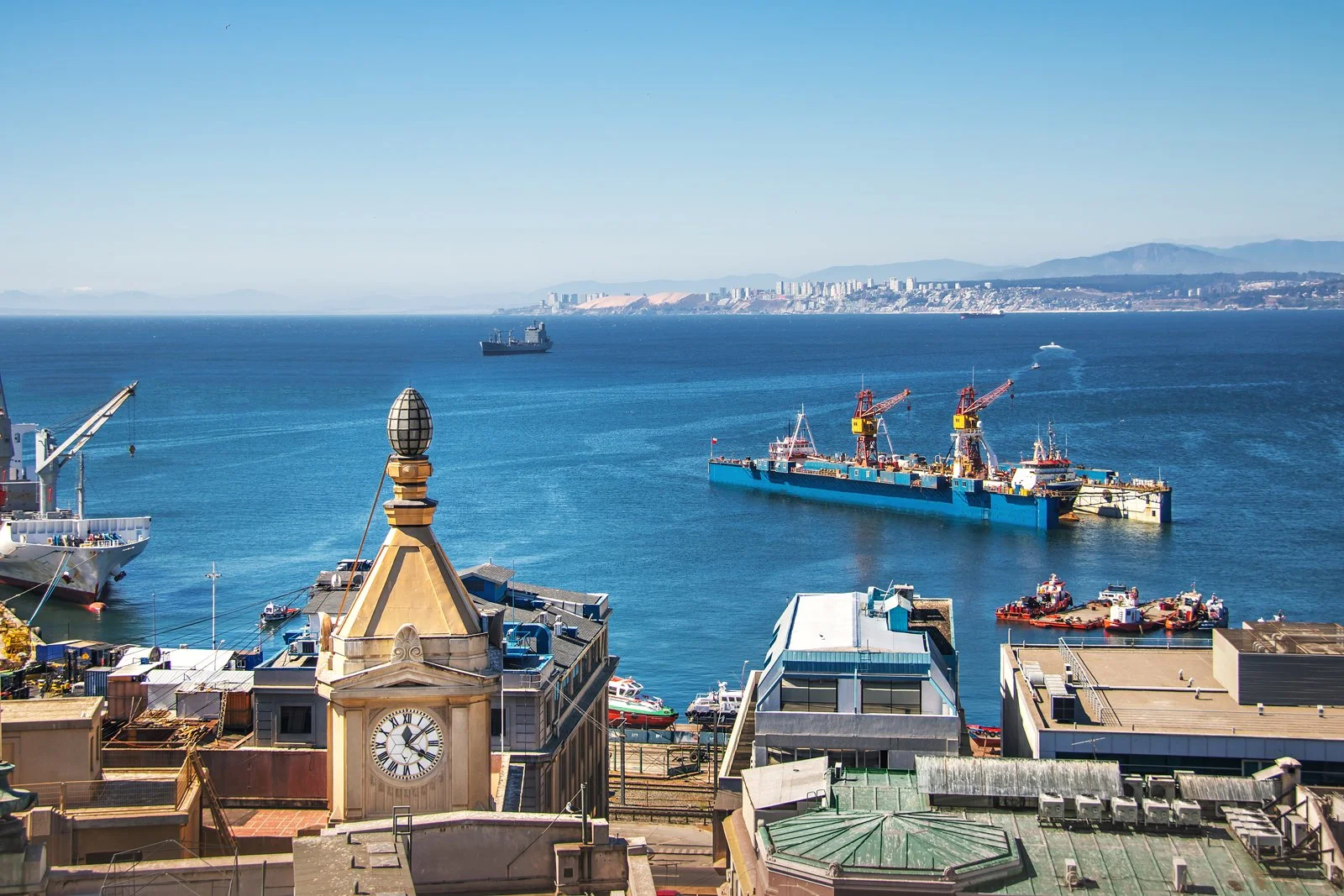
The commercial heart of Valparaíso: its harbour
Getting around Valparaíso and the establishment of funiculars
The oldest funicular, Ascensor Concepción, opened in 1883 to connect two major historic areas in the city: downtown Pasaje Elías and Paseo Gervasoni in Concepción Hill. The construction of around thirty funiculars between 1883 and 1916 was crucial in the expansion of the city and ease of resident access.
Ascensor Concepción is located within the UNESCO World Heritage-listed centre and was officially declared a historic monument in 1998. Originally fitted with wooden cabins and functioning by way of a water counterweight, the funicular is still in operation today via an electric propulsion system and is a testament to the city’s innovative architecture and industrial development.
With sixteen historical funiculars now listed as national monuments in Chile, and around seven still in operation, this mode of transportation is a great way to explore different sections of the city and offers a convenient alternative to walking up the many hills! Some funiculars offer stunning views of the city’s vibrantly coloured buildings and can be combined with other activities, such as Ascensor Artillería and the local craft market in nearby Cerro Artillería. Others – like Ascensor El Peral, located near Plaza de la Justicia – provides access to Cerro Alegre, a lively area with cafes, cultural centres and striking murals.
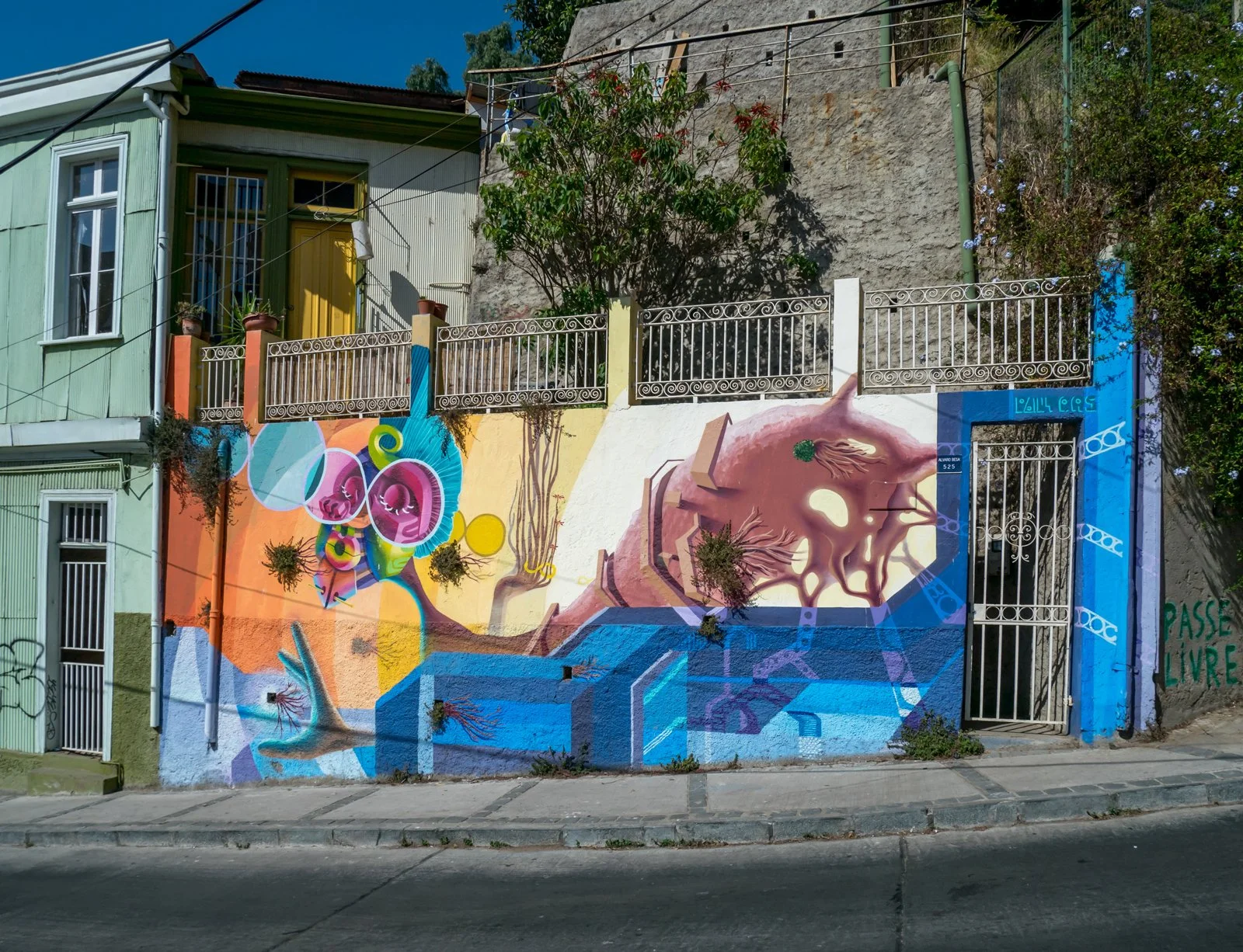
Street art in Valparaíso: an open air museum!
Valparaíso: the unofficial culture capital of Chile
This street art is connected to the political history of Chile in the 1970’s. Once used as a platform to protest social and political issues under military dictator Pinochet’s rule, the murals – depicting powerful figures of resistance such as Salvador Allende and Pablo Neruda – were often erased by authorities within a few days of their creation.
Despite this potential ephemerality, the mural and street art scene in Valparaíso has continued to thrive. Nobel Prize-winning poet Pablo Neruda was an important influence in the preservation of street art, inviting muralists to practice here after being inspired by what he had seen of Mexico’s mural movement. As a result, Valparaíso is brightly coloured, with the arts scene and its creatives underpinning the city’s status as Chile’s unofficial culture capital.
The Museo a Cielo Abierto (Open Air Museum) on Bella Vista Hill comprises approximately 20 murals by high-profile artists such as Roberto Mattta and Mario Carreño, as well as local residents like Maida K – one of the few women in the Chilean mural and street art scene. Teo’s much-loved Van Gogh pastiche on Calle Templeman and Inti Castro’s 50-metre Mural de Valparaíso are also among the standouts.
Many of the murals are not signed and, in their detail, speak to the length and breadth of Chilean history and culture, so it’s not a bad idea to consider taking a guided tour of Valparaíso’s best street art.
Pablo Neruda’s floating house, La Sebastiana
Valparaiso was not just a creative hub for visual artists and muralists; it was also a place of inspiration for writers such as Rubén Darío, whose famous collection Azul was inspired by Valparaíso and was integral to the literary movement of Modernismo.
Similarly, renowned Chilean poet Pablo Neruda (1904–1973) had a strong connection to Valparaíso, where he worked and lived towards the later part of his career. Winner of the Nobel Prize for Literature, Neruda wrote works that were translated and published in multiple languages. His celebrated poem Oda a Valparaíso (Ode to Valparaiso, 1954) pays homage to the city’s lively essence, characterised by its “secretive, sinuous, [and] winding” landscapes.
Neruda roped his friends into finding him a Valparaíso apartment suitable to his needs (and his many complex and ironic criteria!), eventually moving into a home here that was built by Sebastián Collado. Neruda’s house is named for the architect, and La Sebastiana now spans five stories, with a museum filled with models of ships, figurines, statues, paintings, maps, entomology specimens, and antique wooden furniture. With parts of the interior designed to mimic a merry-go-round – including a curved platform and a standing horse – the house’s whimsical essence is connected to Neruda’s belief that his house was a living thing, an extension of himself. In his writing, Neruda depicts La Sebastiana as “made first from air” and “floating in the sky” (La Sebastiana, 1962), and it is well worth visiting on a guided tour.

A day trip from Valparaíso: Pomaire, with its reduction-fired pottery
Day trips: Viña del Mar to Pomaire
While there is much to engage you in Valparaíso, you might like to consider excursions from the city. The Francisco Fonk Archaeological Museum, named after a German doctor and philanthropist, is located just north of Valparaíso in Viña del Mar, and has a small but impressive collection of pre-Colombian artefacts such as ceramics and hieroglyphics.
From a 500-year-old monolithic Moai statue on display at the entrance and collections from Rapa Niu (Easter Island) to artefacts from Chile’s Atacameños (Atacama people), the museum also encompasses collections of objects from the Mapuches (the indigenous peoples of central and south Chile and south-western Argentina) and Diaguitas, or indigenous peoples of Norte Chico and north-west Argentina.
Other easy day trips are to Viña del Mar, which boasts a number of museums, and nearby Concon with its extraordinary sweeping sand dunes. The small village of Pomaire, about 1.5 hours from Valparaíso, is known for its artisanal black pottery, made with reduction firing techniques in traditional wood-burning kilns. The village is best known for its clay chanchitos (small 3-legged pig figurines that bring their recipients good luck) and local gastronomy – namely, super-sized empanadas!
Vineyards: Viña del Mar, Casablanca and Maipo valley
It would be remiss to leave Valparaíso without taking advantage of the easy access it offers to well-known wine regions such as Casablanca Valley, Maipo Valley and the Aconcagua. The cool climate of these regions, coupled with their rich, diverse soil, enables local vineyards to flourish.
Casablanca Valley, best known for Sauvignon Blanc, Chardonnay and Pinot Noir, is just 30 minutes from Valparaíso, and boasts award-winning wineries such as Casas del Bosque and the family-run Bodega RE. Similarly, Aconcagua and Maipo are renowned for their wineries, with Maipo Valley commonly referred to as the ‘Bordeaux of South America’.